

“WELCOME, SISTER DEATH”: REFLECTION ON THE TRANSITUS OF ST. FRANCIS OF ASSISI (1226 – 2026)
Friar Akpos, Onome MICHAEL OFMCap
In our world, and especially in many Nigerian communities and families, death is often spoken of in whispers. It is seen as an intruder that comes too soon and takes away what we cherish most: life itself. We fear death because it is unpredictable; it reminds us of our weakness, cuts short the work we hope to accomplish, and separates us from those we love. Yet Saint Francis of Assisi offers us a different way of looking at death. He called her “Sister Bodily Death.” In doing so, he did not deny the pain of death or the sorrow of separation. Rather, he received death within the horizon of his faith in God and eternal life. For Francis, death was not simply an enemy to be feared, but the final passage of a life entrusted to God.
As we mark the 800th anniversary of the Transitus of Saint Francis in 2026 (1226-2026), his Transitus invites us to see death in the light of Christian hope. His final days challenge us to ask whether a life shaped by faith, love, conversion, and surrender can enable us to approach death with greater peace and trust in God.
Transitus is a Latin word meaning “passage,” “crossing,” or “transition.” In Franciscan spirituality, the Transitus of Saint Francis refers to his passing from this earthly life into eternal life with God. Francis died at the Portiuncula on the evening of 3rd October 1226.
Francis' final years were marked by serious physical suffering and declining health. His eyesight had deteriorated severely, and he endured other physical ailments. Yet his suffering did not extinguish his spirit of praise. In 1225, during a period of intense physical and spiritual suffering, he composed the Canticle of the Creatures. As death drew near in 1226, he added the stanza praising God through “Sister Bodily Death”
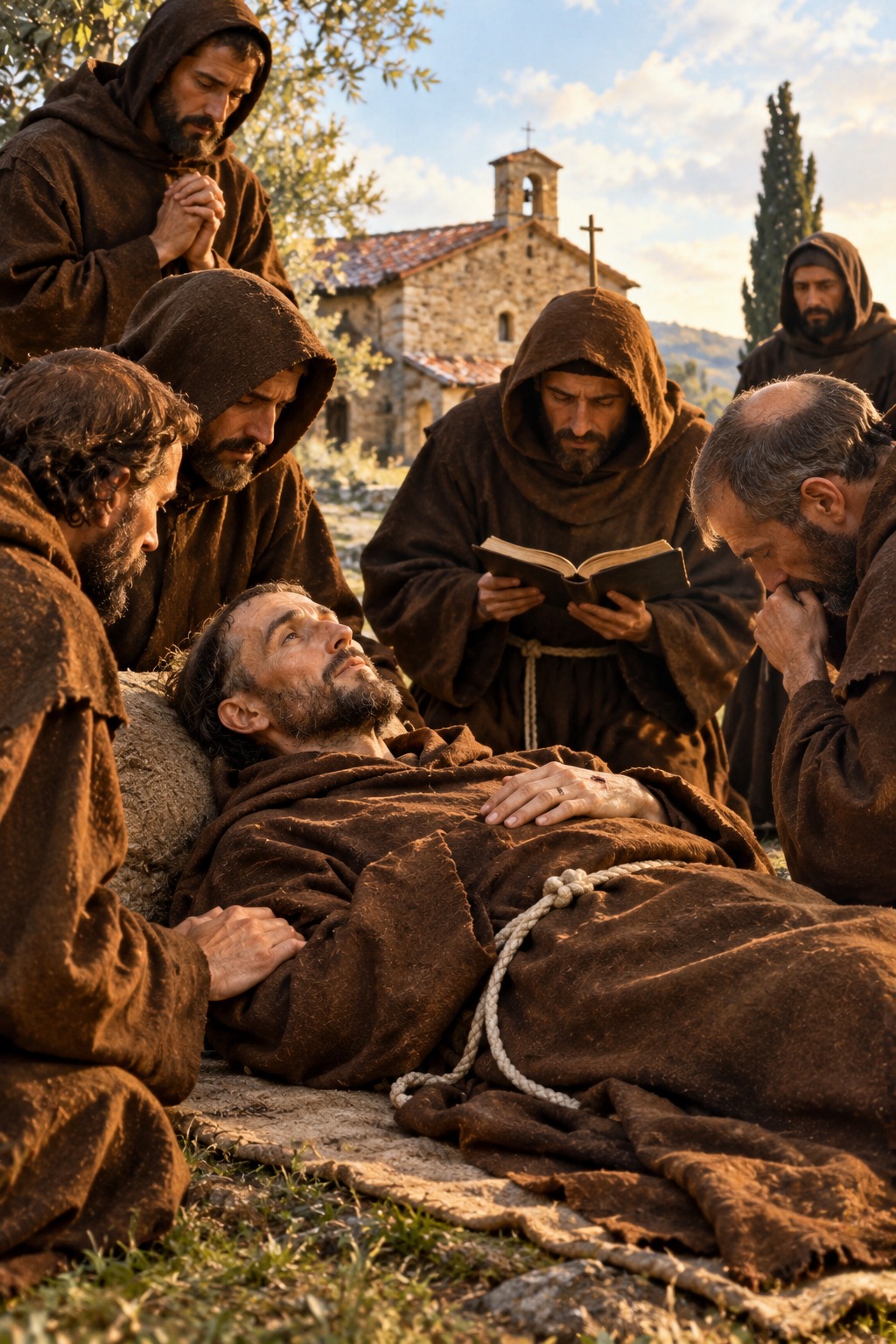
When Francis knew that death was near, he asked to be taken to the Portiuncula, the place so closely associated with the beginnings of his vocation and the Franciscan fraternity. There, surrounded by his brothers and companions, he prepared for his final moment. According to the account of Saint Bonaventure, Francis asked that the Gospel according to Saint John be read to him, beginning with the account of the Last Supper. He then prayed Psalm 142 before peacefully surrendering his spirit.
Francis also blessed his brothers during his final hours. In his Testament, he blessed his brothers and exhorted them to remain faithful to the Gospel and to the life they had promised to live. His death brought sorrow to those who loved him, but his life had taught them that death does not have the final word. The marks of Christ's Passion on his body became a powerful sign of his profound conformity to Christ.
One of the important lessons we can learn from Saint Francis is his attitude towards death. Francis' expression does not mean that death itself is something desirable or that the pain of losing a loved one should be ignored. Rather, it expresses his confidence in God's promise of eternal life.
Francis' example teaches us to live faithfully while placing our ultimate hope in God. Christian faith does not pretend that death is easy; rather, the resurrection of Christ gives believers hope beyond death.
Francis also teaches us the importance of trusting God amid suffering. His physical weakness did not prevent him from praising God. His example reminds us that our relationship with God should not depend solely on whether life is comfortable or difficult. Faith calls us to trust God in both joy and sorrow, in strength and weakness. His life further shows that preparation for death begins with the way we live. We do not have to wait until our final moments before turning towards God. Every day gives us an opportunity for conversion, repentance, prayer, forgiveness, and growth in holiness.
The example of Francis also reminds us of the importance of reconciliation and fraternity. His final days were marked by his concern for his brothers and by the blessing he gave them. We should therefore not wait until our last moments before making peace with others. We should forgive, ask for forgiveness, pray for one another, and express our love and gratitude while we still have the opportunity.
The Transitus of Saint Francis therefore speaks not only about how to die, but also about how to live. His peaceful acceptance of death was connected to a life continually surrendered to God. He had learned to recognize God's presence in creation, fraternity, poverty, suffering, and the Gospel. “Welcome, Sister Death” is therefore more than a beautiful expression associated with Saint Francis. It is an invitation to examine the way we live. It challenges us to remain close to God, to forgive others, to seek reconciliation, and to place our hope in eternal life.
When our own Transitus eventually comes, may we be able to surrender ourselves into the merciful hands of God with faith and trust. Saint Francis teaches us that we prepare for death not merely by thinking about dying, but by learning to live each day with Christ.
The best preparation for death is to learn how to live every day with Christ.


Leave a Comment