

OYO DIOCESE HOSTS PRIESTLY AND RELIGIOUS VOCATIONAL ASSESSMENT TEST TRAINING
Michael OKEOLA
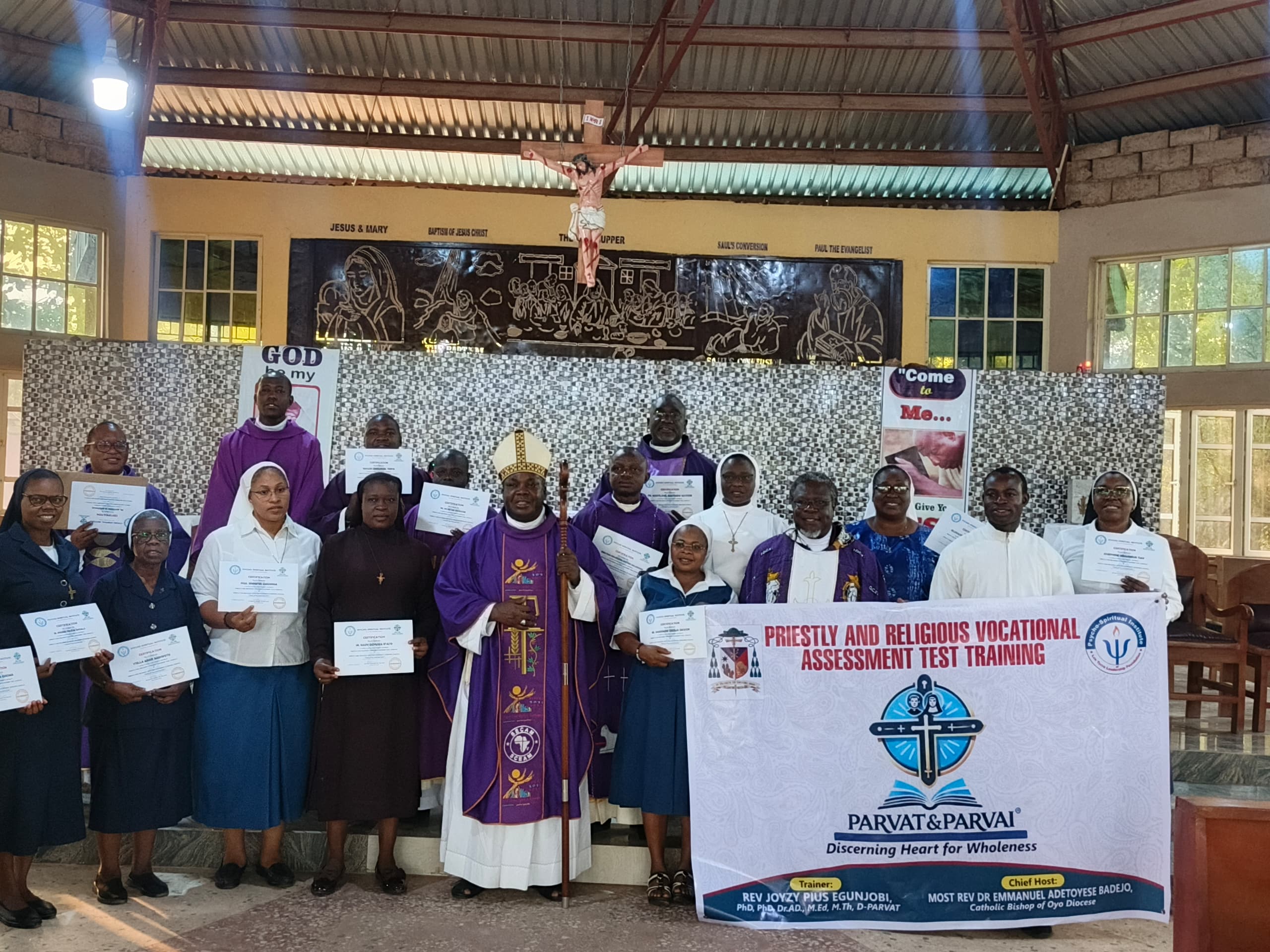
The Catholic Diocese of Oyo recently hosted a five-day Priestly and Religious Vocational Assessment Test Training (PARVAT & PARVAI), organized by Very Rev. Fr. Joyzy Pius Egunjobi, a priest of the Diocese and Director of the Psycho-Spiritual Institute of Lux Terra Leadership Foundation, Nairobi Campus, Kenya. The programme brought together priests, religious, psychologists, counsellors, and formators from various dioceses and religious congregations within and outside Nigeria for an intensive training focused on vocational psycho-spiritual assessment, discernment, and human wholeness.
Participants arrived on Sunday in eager anticipation of the programme, which officially commenced on Monday with the celebration of the Opening Mass presided over by the Catholic Bishop of Oyo Diocese, Most Rev. Dr. Emmanuel Adetoyese Badejo. In his welcome homily, Bishop Badejo expressed deep appreciation to Rev. Fr. Egunjobi for bringing the programme to Nigeria for the first time, noting that it was an offshoot of the degree-awarding Psycho-Spiritual Institute founded in Kenya by Rev. Fr. George Ehusani and now also present in Nigeria. He recalled that similar training opportunities previously required expensive travel to Europe or America, making this initiative both timely and accessible.
The Bishop stressed the urgent need for continuous upgrading of assessment tools for priestly and religious formation, drawing a vivid analogy from national life, warning that poor assessment processes often result in poor leadership outcomes. He explained that proper vocational assessment is dear to God’s heart and reflected Christ’s own method of evaluating those who wished to follow Him, citing Biblical examples where Jesus demanded total commitment, clarity of intention, and readiness to let go of divided loyalties.
Bishop Badejo further noted that the responsibility for sound vocational assessment concerns the entire Church and not Bishops alone, as the consequences affect the life and mission of the Church at every level. He thanked the wide range of participants, including lay professionals, youth, and international attendees, commending their courage in attending despite prevailing security concerns. He also observed that the Scripture readings of the day spiritually affirmed the purpose of the programme, referencing the story of Balaam as an example of God’s use of unexpected paths to accomplish His will.
During the Opening Mass, participants were formally welcomed by the Chairman of the Diocesan Pastoral Council, Mr. Olasupo, alongside representatives of various lay organizations, including the Catholic Women Organization represented by Mrs. Oyatobo, the Diocesan youth, and the Knights of St. John, represented by Sir Ajobiewe, underscoring the shared responsibility of the Church in priestly and religious formation.
Guided by the programme’s theme and tagline, “Discerning a Heart for Wholeness,” the training sessions were carefully designed to equip priests, religious psychologists, and counsellors with appropriate psycho-spiritual tools for assessment, accompaniment, interpretation, and holistic vocational discernment. The sessions covered administration, scoring, interpretation, and reporting, with particular emphasis on ethical standards, confidentiality, and pastoral sensitivity in handling assessment outcomes.
The training concluded on Friday, December 19, 2025, with the celebration of the Holy Mass presided over by Bishop Badejo. In his reflective homily, the Bishop explained that the exercise was never about analyzing individuals in isolation but about shared reflection and collaboration in the Church’s mission of formation. He observed that one reason the Church’s message sometimes appears to have lost its force is the diminished use of storytelling, noting that Scripture itself is built on stories and that Jesus frequently taught profound theological truths through simple narratives. He illustrated this with Biblical stories such as Samson and the annunciation of John the Baptist to Zechariah, explaining that while theology is often presented abstractly today, stories naturally communicate deeper meaning and resonate more strongly with human experience.
Reflecting on the popular saying that God writes straight with crooked lines, Bishop Badejo noted that human lives are rarely straight. Using Samson’s life as an example, he pointed out that despite his flaws, disobedience, and tragic end, God’s purpose was still fulfilled through him. In contrast, Zechariah appeared upright and faithful in his priestly ministry, yet his doubt at the angel’s message led to temporary punishment. From these narratives, the Bishop challenged common assumptions about failure and marginalization, stressing that suffering and trials are not limited to those who fall short but are also part of the journey of those who appear to be doing everything right.
Drawing from Church history, he recalled that psychological assessment was not always part of priestly formation, affirming that while God alone calls, human beings remain privileged instruments in God’s saving plan. He encouraged participants to see themselves as part of God’s unfolding story, noting that even imperfect efforts can contribute meaningfully to the Church’s mission, and he prayed that the programme remains a lasting source of faith and inspiration in their lives.
At the conclusion of the training, Rev. Fr. Joyzy Pius Egunjobi expressed gratitude to the Bishop of Oyo Diocese for his encouragement, support, and approval to host the programme. He explained that the training focused on the responsible use of the psycho-spiritual assessment tools PARVAT and PARVAI, emphasizing that psychological assessment should never be treated as a final determinant of vocation but as a supportive instrument for discernment and growth. He stressed the importance of conducting assessments both before admission into seminaries or formation houses and throughout a candidate’s vocational journey. He also highlighted the broad participation drawn from different parts of West Africa, including Ghana, Abuja, Lagos, Akure, Ibadan, and Osogbo, noting that the programme, which began in Kenya, has attracted participants from Eastern and Southern Africa as well.
In a detailed interview, Rev. Fr. Egunjobi spoke extensively on the challenges of organizing the programme in Nigeria, particularly in terms of awareness, registration, and logistics. He expressed gratitude for the Bishop’s support and for the availability of the Diocesan Pastoral Centre. He explained that vocational assessment rests on strong theological and ethical foundations, stressing confidentiality, professional competence, and the responsible handling of assessment reports.
According to him, assessment is not meant to expel candidates or reduce vocation to psychological testing, but to understand individuals more deeply and support their growth. He emphasized that vocation remains a mystery and a gift from God which cannot be fully captured by assessment tools alone, though such tools can help to identify early serious psychological challenges, such as schizophrenia or bipolar disorder, which may pose challenge to priestly and religious life and apostolate, thereby ensuring more responsible discernment. He called on Bishops, Religious Superiors, and Vocation Directors to handle assessment reports with patience, professionalism, and deep pastoral sensitivity, always remembering that they are dealing with lives entrusted to them by God.
He further explained that the Priestly and Religious Vocational Assessment Test (PARVAT) and the Priestly and Religious Vocational Assessment Interview (PARVAI) are complementary psycho-spiritual tools developed between 2021 and 2023 and subjected to rigorous processes of validity and reliability. According to him, the tools assess the human, psychological, moral, intellectual, and spiritual dimensions of persons aspiring to or already living the priestly or religious vocation. They also evaluate understanding and lived experience of the evangelical counsels of obedience, chastity, and poverty, pastoral openness, and cultural sensitivity, making them particularly suited to African ecclesial realities.
Several religious sisters also contributed to the programme. Sr. Anthonia addressed participants, stressing that vocational assessment is not merely about testing but about communication, understanding, and responsible accompaniment. She urged Bishops, Superiors, and Vocation Directors to approach assessment as a formative and supportive process rather than a punitive exercise.
Sr. Jennifer, who delivered the vote of thanks, expressed appreciation to the Bishop, the trainer, participants, and all who contributed to the success of the programme, acknowledging the sacrifices made by attendees and highlighting the importance of collaboration and communication in today’s social media-driven world.
In an interview, Sr. Esther Amowe, a Daughter of the Holy Spirit and Psychologist at Dominican University, Ibadan, described the programme as timely and enriching. She explained that while psychological assessment has long been encouraged in the Church, many previously used tools were not fully adapted to ecclesial and African contexts. She praised the tools developed by Rev. Fr. Egunjobi for their holistic, culturally sensitive, and pastoral orientation, integrating spiritual, psychological, and human dimensions of formation, and expressed excitement that such an initiative was taking place in Africa.
Speaking further in an interview, Bishop Badejo emphasized the increasing urgency of psychological and vocational assessment in priestly and religious formation due to growing social, cultural, and ideological pressures affecting young people today. He commended Rev. Fr. Egunjobi for bringing the programme to Oyo Diocese and thanked participants who travelled from far and near, describing the training as a significant contribution to the Church’s ongoing formation efforts.
Another participant, Rev. Fr. Michael Olawuni of the Osogbo Diocese, described the programme as inspiring, rigorous, and deeply relevant, noting that it refreshed and strengthened his commitment to vocational accompaniment. He encouraged priests and religious who could not attend to remain open to continuous formation and authentic growth.
As part of the programme, participants paid courtesy visits to the Bishop in his residence, visited the Cathedral Church and the grave of the late Bishop Emeritus, Most Rev. Julius Babatunde Adelakun, visited the Alafin of Oyo at the palace, and shared fellowship during a dinner at the Supreme Continental Hotel’s Aircraft Restaurant, adding cultural and pastoral depth to the overall experience.
The training ended with renewed commitment among participants to responsible discernment, holistic formation, and deeper collaboration in the Church’s mission of raising mature, balanced, and spiritually grounded priests and religious for the service of God’s people.


Leave a Comment