

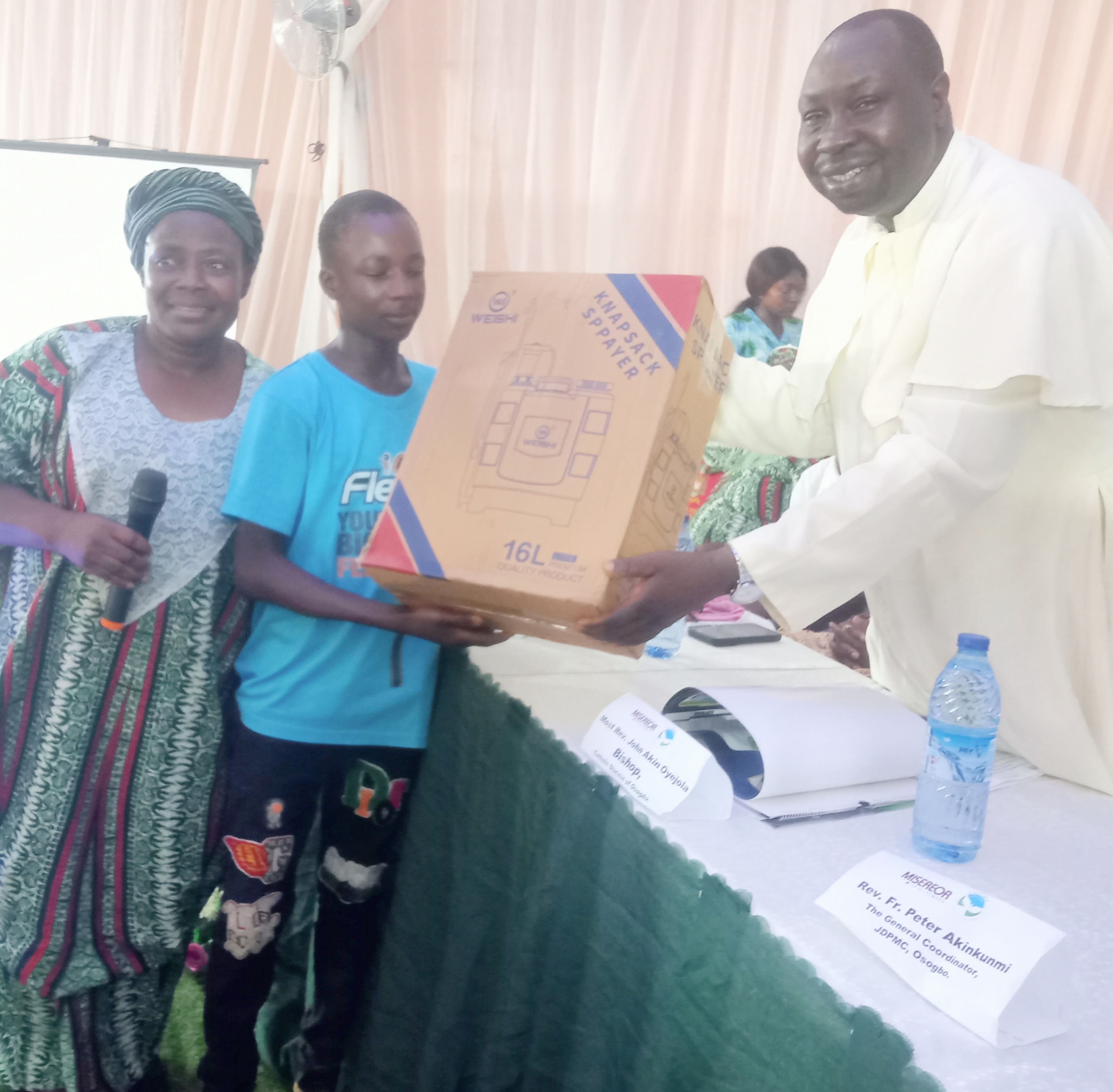
JDPMC Osogbo Clamours for a Cheaper, Better Farming Method Devoid of Harmful Chemicals.
Francis 'Jide MAKINWA
On Thursday, 14th December, 2025, the Rural Development Programme (RUDEP), under the umbrella of the Justice Development and Peace Makers (JDPMC) of Osogbo Catholic Diocese had their annual interactive forum with farmers from 43 rural communities and 41 Pastoralists in Osun State. The event was held at the Conference Centre, Bishop House, Osogbo.
The theme of this year's seminar is "Local seeds conservation, native breeds and organic practices: a necessity for strengthening food security."
The Guest Speaker; Mr. Taiwo Oduola, an Agric Consultant and the national executive member of the Association of Organic Agriculture Practitioners in Nigeria, in his presentation, informed farmers on the need to take good care of our local seeds, improve on them and prepare them for the coming generation. He said farmers are expected to select seeds from the best performing plants through observation and yield evaluations to ensure that the next generation is of better quality and adaptive to local climate and soil.
Mr. Oduola highlighted the effort of the Federal Government on quality seed research. He said Research Institutes have produced local improved seeds. For example, varieties like high yield 'Army Worm' resistant maize, drought resistant maize, low nitrogen resistant maize etc. are already available. Also, we have high yielding disease resistant cowpeas varieties named "Modupe", "Boluyo", "Remilekun" which are improved varieties over the "Ifebimpe" and "Ifebrown" old varieties of cowpeas produced by the Institute of Agriculture Research and Training (IAR &T), Ibadan.
So also, the National Horticultural Research and Training (NIHORT) released improved varieties of Tomatoes, Pepper, Okro among many others recently. The Cocoa Research Institute (CRIN), Idi-Ayunre, Ibadan also has tremendous yield improvement traits on cocoa. All these belong to the farmers’ local seeds environment when adopted for cultivation and conservation activities. Helping and facilitating farmers communities to engage in seed production and conservation will assist a lot as it would limit the access to GMO seeds.
Mr. Oduola urged the farmers to embrace organic farming that promotes resilience especially in the face of climate change ongoing challenges. It enhances the health of the farmer, the consumer and the environment. Organic farming makes crops more robust in resistance to pests, diseases and even drought. It is a way of traditional farming of old imbued with scientific knowledge while using natural herbs and indigenous knowledge systems to solve problems. Organic farming is more enriching and gives more income and profit to farmers due to higher demand. However, in organic production, operators should avoid using chemical products that might endanger human health or the environment. Usage of GMO seeds must be avoided, he emphasized.
In conclusion, Mr. Oduola appreciated the Catholic Church through the JDPMC for the efforts on organic farming.
Mrs. Morenike Onaolapo, the Head of Programmes, RUDEP in her address, said it was discovered that farmers lose much of food crops to pests on the farm and during storage. To curb the menace, and also to enrich the soil through fertilizer, most farmers depend on expensive chemicals that are unfortunately harmful to human beings and damage the ecosystem.
She said, during and after the unfortunate COVID-19 that terrified the world, many people are now cautious of the food they consume; preferably food produced through organic farming.
In order to produce organic farming; food free from artificial agrichemicals, the JDPMC through RUDEP resolved to empower 142 local farmers, males and females from 42 farmers' union and present them as Local Innovation Ambassadors. These Ambassadors were empowered through training and input support. They were trained on how to demarcate their farmland to control and treat a portion of it in order to observe changes and efficacy of indigenous pest and disease management using local inputs like neem (Azadirachta indica), "ewe Akintola" or Siam weed (Chromolaena odorata), tobacco (Nicotiana), sunflower (Helianthus annuus), garlic (Allium sativum), alum (potassium aluminum sulfate), pepper and soap solution.
The results from the research have proved that garlic/pepper/neem /soap solution is very potent for the eradication of 'army worm' infestation on maize and cowpea farm and also serves as foliar fertilizer. Also, Siam weed/neem/alum/soap solution proved to be potent in the control of black pod disease of cocoa. It also serves as organic fertilizer. Neem/sunflower/tobacco/soap solution's efficiency was confirmed on leafy and fruity vegetables' production. The economic advantage is that very little money is spent on procuring the local inputs compared to purchasing fertilizer.
She promised that the results would soon be gathered, evaluated, standardized and released for the use of farmers in Osun State through the media.
On the sub-theme of the day; "Native breeds of animal improvement for sustainable livestock production" presented by Dr. Joseph Tanimowo, the Director of Veterinary Services, Osun State Ministry of Agriculture and Food Security, he said the improvement of our local breeds of animals is best achieved through strategic breeding programme, improved nutrition and housing, good, responsible and proactive animal health management and timely and adequate record keeping.
Earlier, in the welcome address of the JDPMC General Coordinator; Rev. Fr. Peter Akinkunmi, he said the mandate given to the JDPMC by the Bishop is to work with all persons of goodwill to build a society where every human being without bias to religion, race or creed would live and attain the life of dignity willed for them by God with priority to the poor and the most vulnerable of our society. To do this, JDPMC works to promote good governance, human rights and the development of human capital.
The Priest said in this year's Farmers’ Forum, the reflection was focused on promoting food security through the promotion of the use of inputs available in our local environment.
He thanked the Bishop who facilitated access to various organizations of the Catholic Church in various parts of the world to ensure that funds and technical support are available for JDPMC programmes. In this regard, he appreciated in particular, Misereor Germany and the European Union.
The Catholic Bishop of Osogbo Diocese; Most Rev. John Oyejola appreciated and thanked Fr. Akinkunmi and his JDPMC team for their efforts on Agriculture. He recalled that the first profession in the world is farming and without which we cannot live. He said that through the Programme, the Church is encouraging people to use what God created well and make life better for everyone.
Distinguished individuals and organizations that have partnered with JDPMC towards humanity and community development were recognized and appreciated at the event. They included HRM Oba Ezekiel Adeniran Agunlejika (Anirinbiogun 1V); Olokebode of Okebode-Ijesa, Dr. Gabriel Abayomi Fayenuwo, Prince Adetunji Apara Esq., Dr. Ganiyu Adeniji (RUDEP Technical Board Chairman), Pastor J.O. Orekunle (Orolu Good Governance Committee Coordinator), Ipetumodu Community Based Mediation Committee, CSP (Dr) Yemisi Opalola MNIPR (DPO Police Apata Division, Ibadan and Dr. Mutiu Agboke (REC, INEC, Osun State).
The event was anchored by Mr. Segun Makinde, Mrs. Jacob, Mrs Jegede Adekunbi and Mr. Festus Ojewumi


Leave a Comment