

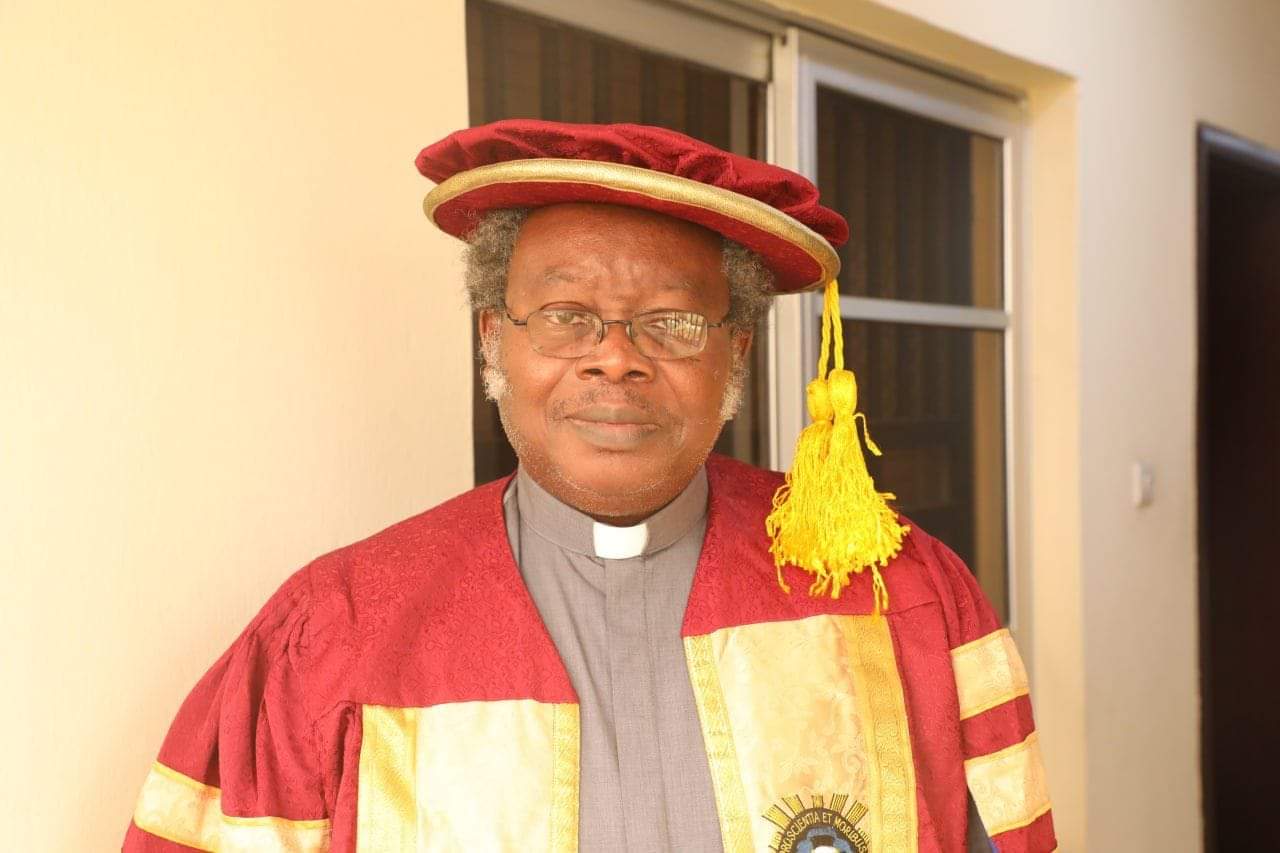
A present of Memory and Hope: Homily on the 70th anniversary of St Finbarr’s College, Akoka, September 25, 2026
Father Anthony A. AKINWALE, OP
About 300 years before the Christian era, Qoheleth, the wise writer of the words of the First Reading of this Mass, spoke of time. There is a time for everything,” he said.
And we hear these words today, seventy years in time since a diminutive but indefatigable Irish visionary and missionary, Fr Denis Joseph Slattery of the Society of African Missions founded our alma mater, St Finbarr’s College. Indeed, seventy years make us look back in time. But what is time?
For us to deeply appreciate what we celebrate today, we need to reflect on that question. What is time?
The question is deceptively simple, and seeking an answer might seem to be an idle banter. Yet, we are not the first to raise the question.
Many years before the Christian era, indeed, years before Qoheleth wrote the words we just heard, a debate was already going on among Greek philosophers. The debate centred on this same question: what is time?
Aristotle, student of Plato, had argued that time can neither begin to be nor cease to be. In other words, time does not exist. And if time does not exist there is no way of speaking of a “before” or an “after”. Now, if that were to be true, it would make no sense to celebrate 70 years of existence of our alma mater.
Plotinus, another disciple of Plato, remarked that we think we know what time is. But when we begin to think about it in depth, that is when it dawns on us that, in fact, we do not know what it is.
This same question would be taken up later by ancient African Christian thinker, St Augustine of Hippo. In the eleventh book of his Confessions, St Augustine made some interesting remarks about time, remarks similar to what Plotinus the Greek philosopher had said. In our familiar everyday conversation, Augustine observed, we speak about time. When we speak of time, we know what we are talking about. But if someone were to ask us: what time is, we would find ourselves in an awkward situation of not knowing how to explain what it is.
What then is time? Is it the past? Is it the present? Or is it the future?
In his philosophical and theological reflection on time, St Augustine considered two tenses—the past tense and the future tense. The past, he said, is not now present; therefore, there is no past. As for future, he continued, the future is not yet present, therefore there is no future. So, there is neither past nor future. But how about the present?
The present is itself illusory, he submitted. It is such that, before we even utter the word “present”, the moment which we want to call “present” is already gone. So, there is no present.
“What is by now evident and clear,” concludes St Augustine, “is that neither future nor past exists, and it is inexact language to speak of three times, ‘past, present, and future’. Perhaps it would be exact to say: there are three times, a present of things past, a present of things present, a present of things to come. The present considering the past is memory, the present considering the present is immediate awareness, the present considering the future is expectation” (Confessions xi, 25).
St Augustine finally gave up trying to describe time in exact language, and he wrote of the three tenses, past, present, and future, saying: “A customary way of speaking is incorrect, but it is common usage. Let us accept the usage. There are few usages of everyday speech which are exact, and most language is inexact. Yet what we mean is communicated” (ibid, 26).
We may not be able to explain what time is in exact words. But life in the world would come to a standstill if time were not to be measured. If there were to be no time, or if there were to be no measurement of time, we would not know when to get out of bed in the morning, when to leave home, when to begin our activities, when to end our activities, when to start this Mass and when to end it. A football referee would not know when to blow the whistle to signify the beginning of a football match. Neither would he know when to blow the final whistle.
In all our undertakings, in every sphere of human endeavour, a practical notion of duration is indispensable. Duration is needed to structure our activities. Our activities need to be structured on the basis of human perception so that life will not come to a standstill. And so, we use clocks and we use watches, we use diaries and we use calendars to give us an idea of where we stand in the flux of time. At the coming of Christ Jesus, God himself came to meet us in this flow of time.
Time is memory. Time is awareness. Time is expectation. And when it is expectation of goodness, time is hope. As memory, time makes us recall the wonders of God in our lives. As awareness, time leads us to know God is still blessing us, working in us and working through us. As expectation, time makes us look forward to the unfolding of God’s goodness to us.
An anniversary is a meeting point of time, past, present and future. This thanksgiving Mass on the 70th anniversary of the foundation of our alma mater is fixed for the feast of St Finbar, the Irish saint chosen by Fr Slattery as patron saint of this school. In our Catholic tradition, time invites us to recall the goodness of God to us, time reminds us to be grateful, time encourages us to live in joyful hope.
The various feasts and anniversaries on our Catholic liturgical calendar bring to our immediate awareness decisive moments in the history of our salvation. But in our immediate awareness, there is memory, and there is expectation. There is, in every anniversary, an immediate awareness of the past and the future.
Indeed, there is no life without immediate awareness, no life without memory, no life without hope. And what is true of life in general is true of the Christian life. Our Christian life is a life of immediate awareness, of remembrance and of expectation. We are Christians because we are aware of the need for salvation, the need for healing. A need which is ours, a need which is the need of our world. We and the world around us are in dire need of healing. Indeed, the incivility we witness in every season of electioneering campaign serves as a brutal reminder that our land Nigeria is in dire need of healing.
Not only do we remember our need for healing, but our Christian faith also reminds us that by the stripes of Christ Jesus nailed to the cross we have been healed. That is the good news that the Christian Gospel proclaims. That is the good news that every Christian missionary must proclaim. That was the good news Fr Slattery brought to Nigeria when he arrived during the Second World War. And he proclaimed it not just by word of mouth, but by his very presence and by his action, by his priestly life and ministry.
The good news Fr Slattery brought took a concrete expression in the founding of St Finbarr’s College in 1956. The 70-year-old history of this great school, a history which is still unfolding, is proclamation of the good news that God is healing the world, and Fr Slattery was an instrument of divine providence in bringing about this healing.
Ignorance is a malady that infects the human intellect. A school is founded to heal the human intellect of ignorance. Seventy years ago, God in his wise direction of the affairs of the universe used Fr Slattery to establish a school that became a leading light in the education sector of a Nigeria preparing for the departure of British colonialists.
We are Christians because we remember the saving deeds of God in the life of our world. That is what we celebrate today. We believe God has already begun the healing process. That is what we celebrate today. Our Christian religion is not opium. We do not deny that there is pain in our world and in our land. After the redemptive healing of the crucified and risen Christ, the human being remains a patient who needs to cooperate with the divine Physician so as to recuperate. And we are Christians because we live in the hope that the fullness of salvation will one day be ours.
The foundation of this school was Fr Slattery’s contribution towards building persons who would build Nigeria. We remember that the work suffered a setback when our alma mater was illegitimately confiscated by the military government. For decades, the good work of Fr Slattery laid in ruins. But here we are rekindling hope by rebuilding, here we are rebuilding by rekindling hope.
Today, we offer the holy sacrifice of the Mass, our sacrifice of praise and thanksgiving, for the blessings of the past seventy years. In thanksgiving to God, we honour the memory of our patron saint, St Finbar. We honour the memory of Fr Slattery, and we honour the memory of all who worked with him to build this school, all who have taught here and all who continue to teach here, all who have studied here and all who continue to study here. We give thanks to God for the many heroic accomplishments of past and present students of this school in academics and in sports, in politics and in religion, in diverse professional undertakings, in various spheres of human endeavour.
In 1956, when this school was founded, it was four years before Nigerian independence. It was a period of positive expectation that Nigeria would be a land of legitimate African pride. Ten years later, with the first military coup, Nigeria stepped on a slippery slope that led to needless bloodshed. We must learn our lessons.
We must constantly cooperate with the grace of God to fill the gap between experience and expectation. By so doing, we would be rebuilding our country Nigeria into a country where no one is deprived of the opportunity to flourish, no one disabled from flourishing. This is the task before us, past and present students of St Finbarr’s, as we celebrate 70 years of existence of our alma mater.
May the grace of God, through the intercession of St Finbar enable us to fulfill this noble task for the glory of God and for the integral development of our dear country Nigeria.


Leave a Comment