

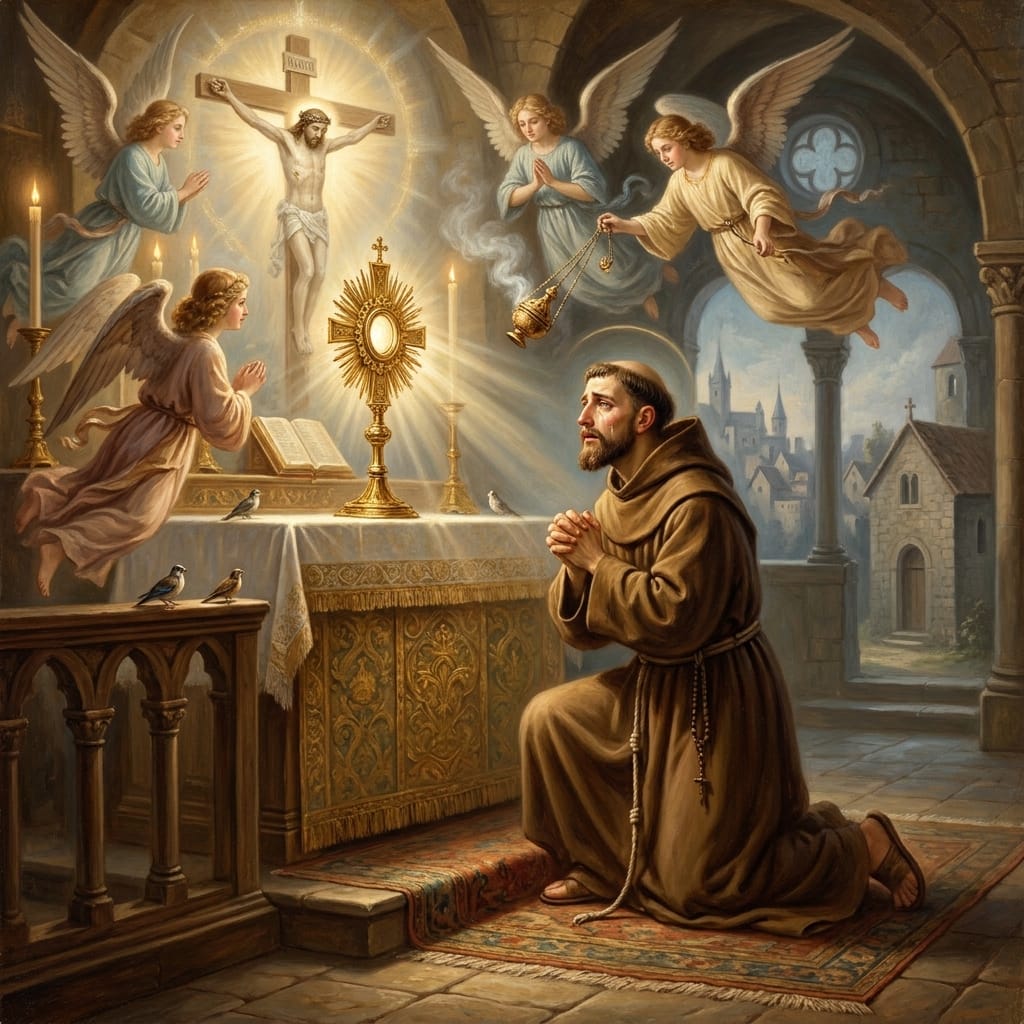
ST. FRANCIS OF ASSISI: A GREAT LOVER OF THE EUCHARIST
JUBILEE YEAR OF ST. FRANCIS OF ASSISI
Friar Thaddeus BINI, OFM Cap.
The celebration of the solemnity of the Most Precious Body and Blood of Our Lord Jesus Christ during the Jubilee year of St Francis of Assisi strongly reminds us that the true centre of the spirituality and strength of St Francis of Assisi was his profound devotion to the Eucharist
In the Eucharist, Francis sees the “poor and humble” Christ continually present among His people. With remarkable theological insight, he understood the Eucharist as a re-enactment of the mystery of the incarnation. In his Admonition, he writes, “Behold, daily He humble Himself as when from heaven’s royal throne He came into the womb of the Virgin. Daily He Himself comes to us with humility; daily He descends from the bosom of the Father upon the altar in the hands of the priest.” (Adm. 1; 16-19)
Therefore, faith in the real presence of Christ in the Eucharist is a fundamental requirement for salvation. Conversely, refusal to believe in the real presence of Christ in the Eucharist leads to condemnation. By way of affirmation, the Seraphic Father writes,
“Therefore, all those who saw the Lord Jesus according to his humanity and did not see and believe according to the Spirit and Godhead that He is the true Son of God were condemned. Now, in the same way, all those who see the sacrament of the body and blood of the Lord upon the altar, sanctified by the words of the Lord through the hands of the priest, and do not see and believe according to the spirit and Godhead that it is truly the Most Holy Body and Blood of our Lord Jesus Christ are condemned. This is attested by the Most High Himself, who says: ‘My Body and the Blood of my New Testament.’” (Adm. 1; 6-10).”
The use of the term “condemned” by the Seraphic Father, Francis, may sound severe to modern ears. Nevertheless, Francis grounds this teaching on the words of Our Lord Jesus Christ: “Unless you eat the flesh of the Son of Man and drink His Blood, you have no life in you” (Jn 6:53).
Participation in the Holy Sacrifice of the Mass and veneration of the Body and Blood of Jesus were pivotal for St. Francis. Almost all his writings contain exhortations regarding the Eucharist. In his letter addressed to the Entire Order, St Francis admonished the Friar-Priests thus,
“I beseech in the Lord all my brothers who are and who will be and who hope to be priests of the Most High that whenever they wish to celebrate Mass, pure in person and pure in action, they reverently offer the true sacrifice of the most holy Body and Blood of our Lord Jesus Christ with a holy and pure intention, not for any earthly thing nor out of fear or love of any man as though pleasing men but let all their will, with the help of grace, be so directed to God, in the desire to please only the most High Lord Himself because He alone works therein as it pleases Him.”
Thomas of Celano, the first biographer of St. Francis, attests that Francis burned with an all-consuming love for the Sacrament of the Lord’s Body. Failure to attend at least one Mass daily was considered a serious contempt by him. He received Holy Communion frequently with great devotion. The Seraphic Saint expressed the spiritual dignity of those who worthily receive the Eucharist in these beautiful words:
O how happy and blessed are men and women who receive the Body and Blood of our Lord Jesus Christ and bring forth worthy fruit of penance: they are children of the heavenly Father whose work they do, and they are spouses, brothers, and mothers of Our Lord Jesus Christ.
Closely connected with the worthy reception of the Eucharist is the necessity of proper reverence and disposition. Francis writes:
“Listen my brothers: if the Blessed Virgin is so honour as is meet, because she carried Him in her most holy womb; if the blessed Baptist trembled and did not dare to touch the holy head of God; if the sepulchre in which He lay for some time is held in veneration, how holy, upright and worthy must he be who holds in his hands, receive with his heart as well as by mouth and give to other to receive”. (St. Francis' letter to the whole Order, 21-22).
Francis, therefore, placed great emphasis on the veneration of the Body and Blood of Christ, either during the celebration of the Mass or after. Faith and reverence towards the Eucharist were two attitudes he tirelessly promoted. That is why in his Letter to the Clerics, he exhorted priests to exercise the utmost care in administering the Sacraments, especially the Eucharist. He also insisted that all sacred vessels and altar linens that come in contact with the Blessed Sacraments should be kept clean, as well as the Church and everything in it.
Towards the end of his earthly life, the Poor Man of Assisi with great love for the Eucharist wrote in his Testament, “And the Lord gave me such a faith in the churches, that in a simple way I would thus pray and say, we adore you, O Lord Jesus Christ, here and in all your Churches which are in the whole world and we bless you because by your holy Cross you have redeemed the world.”
As we celebrate the solemnity of the Most Holy Body and Blood of Christ during this Jubilee Year of St. Francis of Assisi, we are invited to rediscover the Eucharistic faith of the seraphic father. His life teaches us that the Eucharist is not merely a sacred symbol but the living presence of Christ among His people.
St. Francis of Assisi, ardent lover of the Eucharist, pray for us.


Leave a Comment