

Diphtheria: What you Need to Know.
Dr. Francis SANWO
Diphtheria is an infection caused by the bacterium Corynebacterium diphtheriae. Most infections are asymptomatic or have a mild clinical course, but in some outbreaks more than 10% of those diagnosed with the disease may die. In severe cases, a grey or white patch develops in the throat. This can block the airway and create a barking cough as in croup. The neck may swell in part due to enlarged lymph nodes. A form of diphtheria which involves the skin, eyes or genitals also exists. Complications may include myocarditis, inflammation of nerves, kidney problems, and bleeding problems due to low levels of platelets. The bacterium usually multiplies on or near the surface of the throat or skin. C. diphtheriae spreads through: Airborne droplets. When an infected person's sneeze or cough releases a mist of contaminated droplets, people nearby may inhale C. diphtheriae. Diphtheria spreads easily this way, especially in crowded conditions. Contaminated personal or household items. People sometimes catch diphtheria from handling an infected person's things, such as used tissues or hand towels that may be contaminated with the bacteria. Contact with any lesions on the skin can also lead to transmission of diphtheria, but this is uncommon. Indirect infections can occur, as well. If an infected individual touches a surface or object, the bacteria can be left behind and remain viable It may also be spread by contaminated objects. People who have been infected by the diphtheria bacteria and who haven't been treated can infect people who haven't had the diphtheria vaccine — even if they don't show any symptoms. The symptoms are due to a toxin produced by the bacterium. Diagnosis can often be made based on the appearance of the throat with confirmation by microbiological culture. Previous infection may not protect against infection.
A diphtheria vaccine is effective for prevention and available in a number of formulations. Three or four doses, given along with tetanus vaccine and pertussis vaccine, are recommended during childhood. Further doses of diphtheria–tetanus vaccine are recommended every ten years. People who are at increased risk of catching diphtheria include: children and adults who don't have up-to-date vaccinations, people living in crowded or unsanitary conditions and anyone who travels to an area where diphtheria infections are more common. Diphtheria is still common in developing countries where vaccination rates are low.
In 2015, 4,500 cases were officially reported worldwide, down from nearly 100,000 in 1980. About a million cases a year are believed to have occurred before the 1980s.
Signs and symptoms
Signs and symptoms may vary from mild to severe and often come on fairly gradually, beginning with a sore throat and fever.
The symptoms of diphtheria usually begin two to seven days after infection. They include fever of 38 °C (100.4 °F) or above; chills; fatigue; bluish skin coloration (cyanosis); sore throat; hoarseness; cough; headache; difficulty swallowing; painful swallowing; difficulty breathing; rapid breathing; foul-smelling and bloodstained nasal discharge; and lymphadenopathy. Within two to three days, diphtheria may destroy healthy tissues in the respiratory system. The dead tissue forms a thick, gray coating that can build up in the throat or nose. This thick gray coating is called a "pseudomembrane". It can cover tissues in the nose, tonsils, voice box, and throat, making it very hard to breathe and swallow. Symptoms can also include cardiac arrhythmias, myocarditis, and cranial and peripheral nerve palsies.
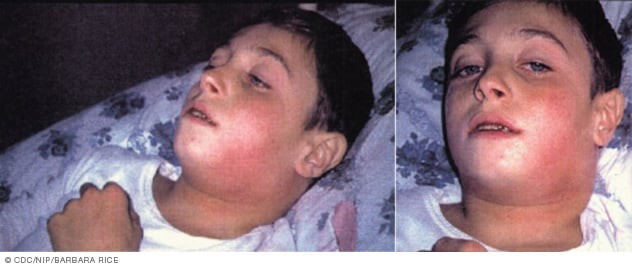
Diphtheritic croup. Laryngeal diphtheria can lead to a characteristic swollen neck and throat, or "bull neck". The swollen throat is often accompanied by a serious respiratory condition, characterized by a brassy or "barking" cough, stridor, hoarseness, and difficulty breathing; and historically referred to variously as "diphtheritic croup", "true croup", or sometimes simply as "croup". Diphtheritic croup is extremely rare in countries where diphtheria vaccination is customary.
Empirical treatment should generally be started in a patient in whom suspicion of diphtheria is high.
Treatment
The disease may remain manageable, but in more severe cases, lymph nodes in the neck may swell, and breathing and swallowing are more difficult. People in this stage should seek immediate medical attention, as obstruction in the throat may require intubation or a tracheotomy. Abnormal cardiac rhythms can occur early in the course of the illness or weeks later and can lead to heart failure. Diphtheria can also cause paralysis in the eye, neck, throat, or respiratory muscles. Patients with severe cases are put in a hospital intensive care unit and given diphtheria antitoxin (consisting of antibodies. Since antitoxin does not neutralize toxin that is already bound to tissues, delaying its administration increases risk of death. Therefore, the decision to administer diphtheria antitoxin is based on clinical diagnosis, and should not await laboratory confirmation.
Antibiotics are used in patients or carriers to eradicate C. diphtheriae and prevent its transmission to others. Erythromycin is given (orally or by injection) for 14 days (40 mg/kg per day with a maximum of 2 g/d), or Procaine penicillin G is given intramuscularly for 14 days (300,000 U/d for patients weighing <10 kg and 600,000 U/d for those weighing >10 kg); patients with allergies to penicillin G or erythromycin can use rifampin or clindamycin.
In cases that progress beyond a throat infection, diphtheria toxin spreads through the blood and can lead to potentially life-threatening complications that affect other organs, such as the heart and kidneys. Damage to the heart caused by the toxin affects the heart's ability to pump blood or the kidneys' ability to clear wastes. It can also cause nerve damage, eventually leading to paralysis. About 40% to 50% of those left untreated can die.
Complications. Left untreated, diphtheria can lead to:
Breathing problems. Diphtheria-causing bacteria may produce a toxin. This toxin damages tissue in the immediate area of infection — usually, the nose and throat. At that site, the infection produces a tough, gray membrane made up of dead cells, bacteria and other substances. This membrane can obstruct breathing.
Heart damage. The diphtheria toxin may spread through the bloodstream and damage other tissues in the body. For example, it can damage the heart muscle, causing such complications as inflammation of the heart muscle (myocarditis). Heart damage from myocarditis may be slight or severe. At its worst, myocarditis can lead to heart failure and sudden death.
Nerve damage. The toxin can also cause nerve damage. Typical targets are nerves to the throat, where poor nerve conduction may cause difficulty swallowing. Nerves to the arms and legs also may become inflamed, causing muscle weakness.
If the diphtheria toxin damages the nerves that help control muscles used in breathing, these muscles may become paralyzed. At that point, you might need mechanical assistance to breathe.
With treatment, most people with diphtheria survive these complications, but recovery is often slow. Diphtheria is fatal about 5% to 10% of the time. Rates of death are higher in children under age 5 or adults older than age 40.
Prevention
Before antibiotics were available, diphtheria was a common illness in young children. Today, the disease is not only treatable but also preventable with a vaccine.
The diphtheria vaccine is usually combined with vaccines for tetanus and whooping cough (pertussis). The three-in-one vaccine is known as the diphtheria, tetanus and pertussis vaccine. The diphtheria vaccine is effective at preventing diphtheria. Complications are very rare. After the initial series of vaccinations in childhood, you need booster shots of the diphtheria vaccine to help you maintain your immunity. That's because immunity to diphtheria fades with time.
“WHO recommends a three-dose primary vaccination series with diphtheria containing vaccine followed by three booster doses. The primary series should begin as early as six-week of age with subsequent doses given with a minimum interval of four weeks between doses. The three booster doses should preferably be given during the second year of life (12-23 months), at four to seven years, and nine to 15 years of age.
“Ideally, there should be at least four years between booster doses,”
Nigeria has so far recorded a total of 123 Diphtheria infections and 38 deaths across four states of the federation as of 22 January.
According to the latest data by the Nigeria Centre for Disease Control (NCDC), Kano State recorded the highest with 100 confirmed infections and 32 deaths, followed by Yobe with 17 infections and three deaths.
Also, in 2018 and 2019, no fewer than 1,870 and 2,289 cases were reported respectively.


Leave a Comment