

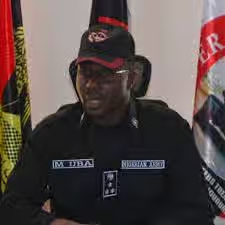
ONE SHOT ENDS THE LIFE OF A BRIG. GENERAL
S.O.S ALIEME
It will be an understatement if we say the military in Nigeria is facing challenges following the kidnapping and subsequent execution of Brig. Gen Uba, the leader of the army that went to fight insurgence in Borno region. The Nigerian military has faced challenges in its fight against terrorism, but this is the first time a high-ranking military officer has been captured, interrogated, and murdered. The capture of a serving commander marks a rare and serious development in the ongoing conflict with insurgent groups in Nigeria.
In recent months, ISWAP has intensified attacks around Damboa and the wider Borno region, escalating the dangers faced by both military personnel and civilians. Security analysts who reviewed the image described the abduction as both an operational setback and a symbolic blow to Nigerian forces fighting the insurgency. Families of soldiers deployed in the area have expressed frustration and anxiety over the conflicting reports about their loved ones’ safety. Borno state is at the centre of the Islamist insurgency, which has spilled into neighboring Chad and Cameroon and has left about 300,000 people dead and millions dependent on aid, the United Nations says.
Military sources and residents said ISWAP fighters attacked Askira with at least 12 gun trucks, burning houses, shops and a school, and forcing some residents to flee. The army had brought in reinforcements but the battle was still ongoing as evening approached, the sources said. Askira is about 150 kilometers South of Borno State capital Maiduguri and lies along the fringes of Sambisa Forest, the operational base of both Boko Haram and ISWAP. Security sources said ISWAP fighters also had separately attacked troops near Maiduguri town, but there were no immediate details on casualties. The tragic incident happened when troops of the 25 Task Force Brigade were ambushed near Wajiroko in Azir Multe, Damboa, Borno State, while returning from a routine patrol around the Sambisa axis after a successful joint air-ground operation. ISWAP fighters reportedly opened heavy fire on the convoy, killing two soldiers and two Civilian Joint Task Force members and scattering the formation. Brigadier General Uba, who led the patrol team, was separated from his men during the gun battle and fled into the forest. Shortly after, news began circulating that ISWAP had killed the commander. But in a response, the Nigerian Army swiftly dismissed the reports, insisting Brig Uba had made it safely back to base. But ISWAP countered the Army statement by publishing photo evidence and issuing a detailed account accusing the military of ‘lying to Nigerians’.
According to the terror group, their ambush was not specifically targeted at Uba’s convoy but was positioned for any passing military formation. After the initial attack, the insurgents said they learned the Brigade Commander had escaped with a gunshot wound to the leg, prompting them to mobilise and comb nearby villages. He was reportedly located, captured, interrogated and executed. The conflicting narratives have triggered nationwide outrage, with many Nigerians calling the incident a ‘major indictment’ of the military’s communication practices and broader counter-terrorism strategy. The death of Brigadier General Uba marks one of the most serious battlefield losses for the Nigerian military and the entire country as a whole in recent years, heightening concerns over operational vulnerabilities in the North-East and deteriorating trust between citizens and security institutions.
The issue of insecurity in this country Nigeria has become a source of worry for both the people and the government. The spate of killings in Nigeria these days is alarming and it seems nobody is safe. If the government security operatives are finding it difficult to curtail insurgencies in Nigeria, then who can stand? The federal government is not paying sufficient attention to the issue of these killers and their tyrannical tendencies all over the country. The situation is getting grimmer by the day, it could result in an expansive conflagration that might be difficult to contain. There is no question about the fact that this is becoming a monster of sorts. The menace is gradually moving towards a precipice and we must do something about it as early as possible. It is getting dangerous. The audacity is very disturbing.
Government should as a matter of urgency allow for community policing in all areas of the country. Government should also strive to provide enough and sophisticated security personnel in order to tackle security challenges, such as robbery, extortion, rape, kidnapping and hijacking people’s properties. Nigerians need to absolutely cultivate the habit of security consciousness and rapidly report any equivocal security situation to the appropriate authority immediately. Nigeria as a country must put in place a process to deal with contentious issues in the constitution such as resource mobilisation and control, citizenship, religion and ethnicity. Government should put in place a robust development programme that should be seen to be addressing the developmental challenges of unemployment, illiteracy, and corruption. Government must as matter of urgency create and provide gainful employments for school leavers so that they don’t turn to social misfits.
Nigeria needs this cultural transformation to emancipate her from incessant attacks, economic woes and political impasse. Nigeria needs serious prayers. If the Army is not Safe, who then is safe!!! God come to our aid. Amen.
God Bless Nigeria!!!


Leave a Comment