

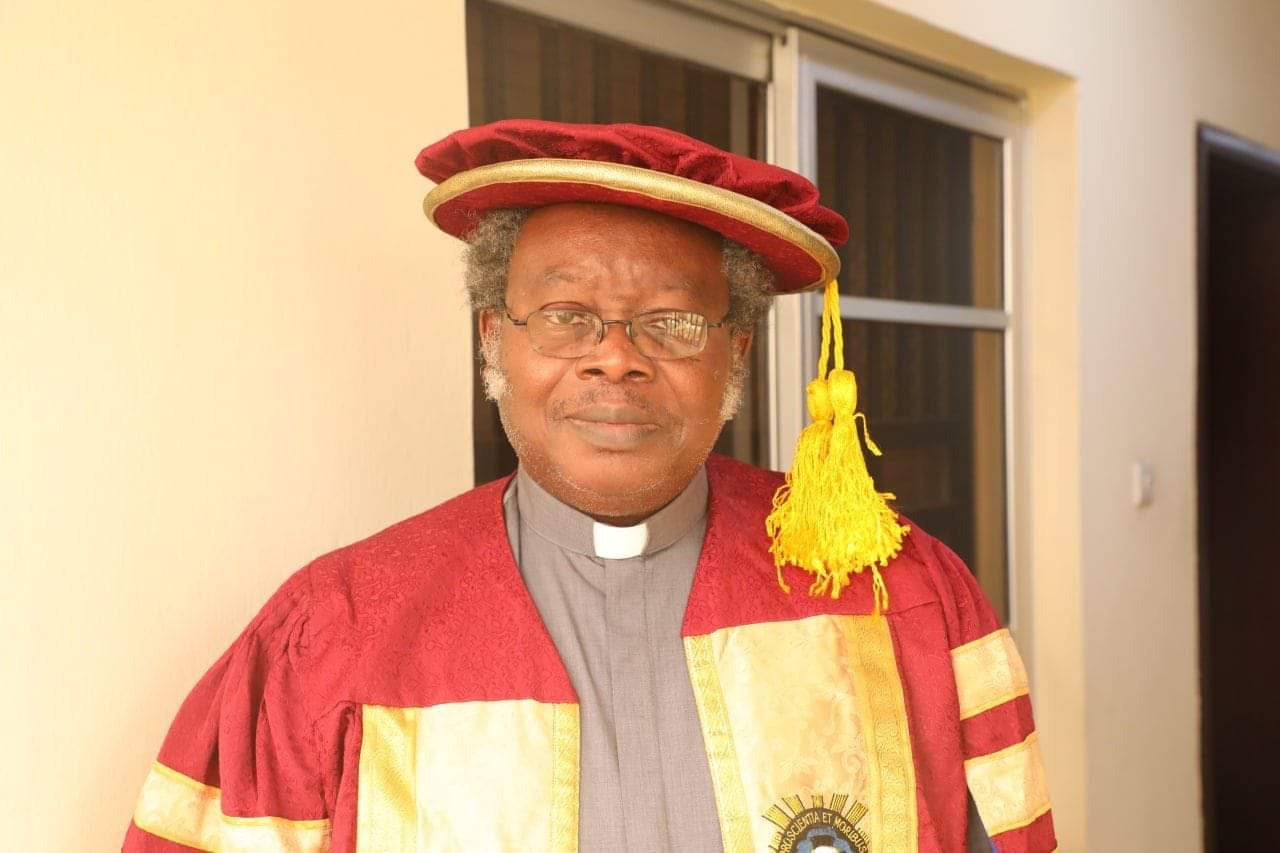
Guns-a-Blazing (3) Thought for the Week, November 30, 2025
Continued from last week
President Trump is not the only world leader interested in Nigeria. It is certainly a matter of interest that Pope Leo lent his voice to the voices of many who are concerned about persecution of Christians in Nigeria and in other countries.
In his message before leading recitation of the Angelus at St Peter’s Square on Sunday, November 16, 2025, Pope Leo XIV, taking his cue from the Gospel of the day (Lk 21:5-19) called attention to what the Gospel passage communicates. It is an invitation “to reflect on the travails of history and the end times.” We are not to be overcome by fear in the face of wars, insurrections and persecution. For Jesus said: “When you hear of wars and insurrections, do not be terrified” (v. 9).
Pope Leo went on to draw a lesson on the pertinence of the message. “His [Jesus’] appeal is very timely because unfortunately we receive daily news about conflicts, disasters and persecutions that torment millions of men and women. However, in the face of these afflictions, and in the face of the indifference that seeks to ignore them, Jesus’ words proclaim that the attack of evil cannot destroy the hope of those who trust in him. The darker the hour, the more faith shines like the sun.
“Twice, in fact, Christ affirms that ‘because of my name’ many will suffer violence and betrayal (Lk 21:12, 17), but precisely then they will have the opportunity to bear witness (cf. v. 13). We are called to follow the example of the Master, who revealed the immensity of his love on the cross. This encouragement concerns us all. Indeed, the persecution of Christians does not only happen through mistreatment and weapons, but also with words, that is, through lies and ideological manipulation. Especially when we are oppressed by these evils, both physical and moral, we are called to bear witness to the truth that saves the world; to the justice that redeems peoples from oppression; to the hope that shows everyone the way to peace.”
Having led in recitation of the Angelus, Pope Leo XIV concluded: “As I just mentioned in my reflection on the Gospel, Christians today are still suffering from discrimination and persecution in various parts of the world. In particular, I think of Bangladesh, Nigeria, Mozambique, Sudan and other countries from which we often hear news of attacks on communities and places of worship. God is a merciful Father, and he desires peace among all his children!”
Unlike President Trump, Pope Leo has no army, no military might. While he recognized the humanitarian dimension of the Nigerian story, he is not threatening to send troops to Nigeria to liberate Nigerians. But he has the moral force of the Gospel of Christ and of Catholic social doctrine behind his pronouncement. Like the United Nations Charter, Catholic social teaching is unequivocal in its opposition to unilateral military intervention even on humanitarian grounds.
President Trump’s threat to invade Nigeria on humanitarian grounds fails the litmus test of Catholic social teaching. Anchored on the Gospel of Christ, and on the just war theory as articulated by St Augustine of Hippo and St Thomas Aquinas, Catholic social teaching not only prescribes a just war theory, it includes criteria for such a war to be just. It must be waged for a just cause, through proportional deployment of just means, with a high probability of a successful outcome, that is, an outcome that does not cause more harm than it set out to remedy, and it must be waged by a legitimate authority, in this case the United Nations, not by the President of a powerful nation speaking and acting unilaterally.
In his Address to the 50th General Assembly of the United Nations, on October 5, 1995, Pope John Paul II recognized that national sovereignty is not absolute but subject to the common good because nations form a “family of nations”. At the same time, Pope John XXIII’s teaching in his encyclical Pacem in Terris is not to be ignored when he spoke of the necessity of “a legal structure in conformity with the moral order” for the stability of international relations. Pope John Paul II would reecho Pope John XXIII when he counselled that political communities must be subject to common rules in a commitment to negotiate and to definitively reject the proposition that justice can be attained through recourse to war (Centesimus Annus, 23).
Later, in his Year 2000 Message for the World Day of Peace, Pope John Paul II affirmed: “War is never just another means that one can choose to employ for settling differences between nations.” The imperative of common subjection to common rules in international relations would inform Pope John Paul II’s condemnation of the 2003 American unilateral military intervention in Iraq. The 2003 American invasion of Iraq was without authorization by the United Nations. President George Bush Jr had justified it on the grounds of a theory of preemptive strike.
On his part, Pope Benedict XVI, in his 2008 Address to the United Nations five years after the American invasion of Iraq pointed out that “The principle of the responsibility to protect was developed to prevent and stop atrocities... It is not a limitation of sovereignty, but a strengthening of it.” While the international community bears moral burden to protect populations from genocide, war crimes, ethnic cleansing, and crimes against humanity, and while this burden implies a duty on the part of the same international community to intervene when governments fail to protect their own people, this duty is to be assumed, not unilaterally, but through interventions authorized by lawful international institutions. In the words of Pope Benedict XVI, “Action should always be taken within the framework of the United Nations and according to international law.” (UN Address, April 18, 2008)
. Nigeria’s problems are fundamentally moral and political. We must put an end to willful, cynical and manipulative mismanagement of our diversity by our political elite. The long journey towards a peaceful Nigeria will begin with a sincere effort to give ourselves a constitution that will establish strong institutions to protect us, manned by men and women whose strength is neither in the militia they gather and arm, nor in the large sums of money they deploy in every election season, but in their intellectual, ethical and administrative competence. The long road we must travel is a journey on the expressway of integrity. Concluded
Father Anthony Akinwale, OP


Leave a Comment